
Blade vs mallet putters: which suits your stroke?
A blade suits an arcing stroke and a mallet suits a straighter one. That is the short answer, and it is right most of the time. The spec that actually does the matching is toe hang, and the neck sets it, not the head. Of the 967 putters in our catalog with one listed toe hang, 61% of mallets are face-balanced and 86% of blades have toe hang. Work out your stroke first, then pick the balance, then the shape.
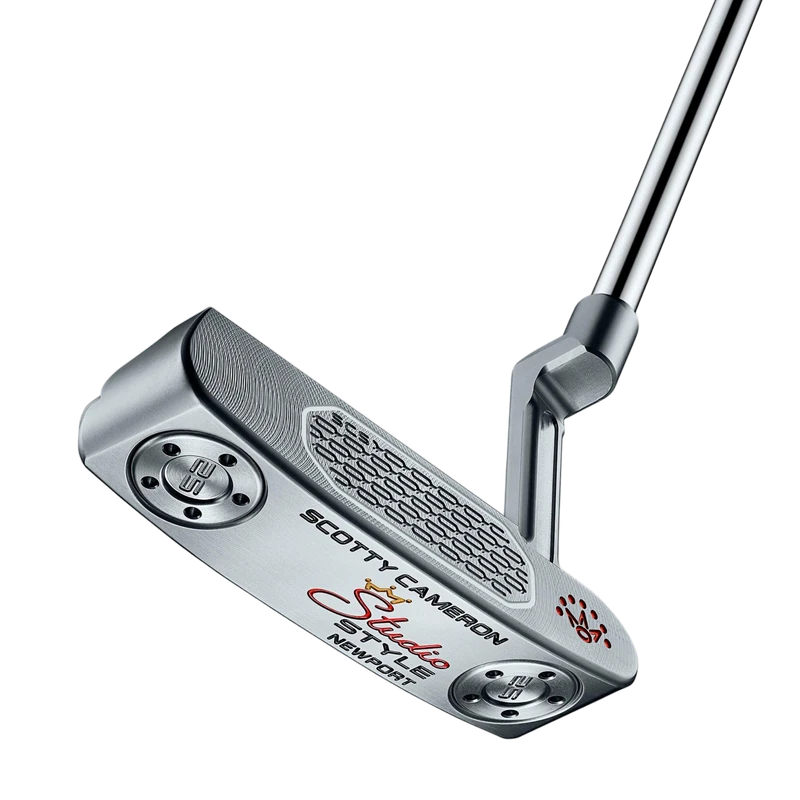 BladeScotty Cameron Studio Style Newport
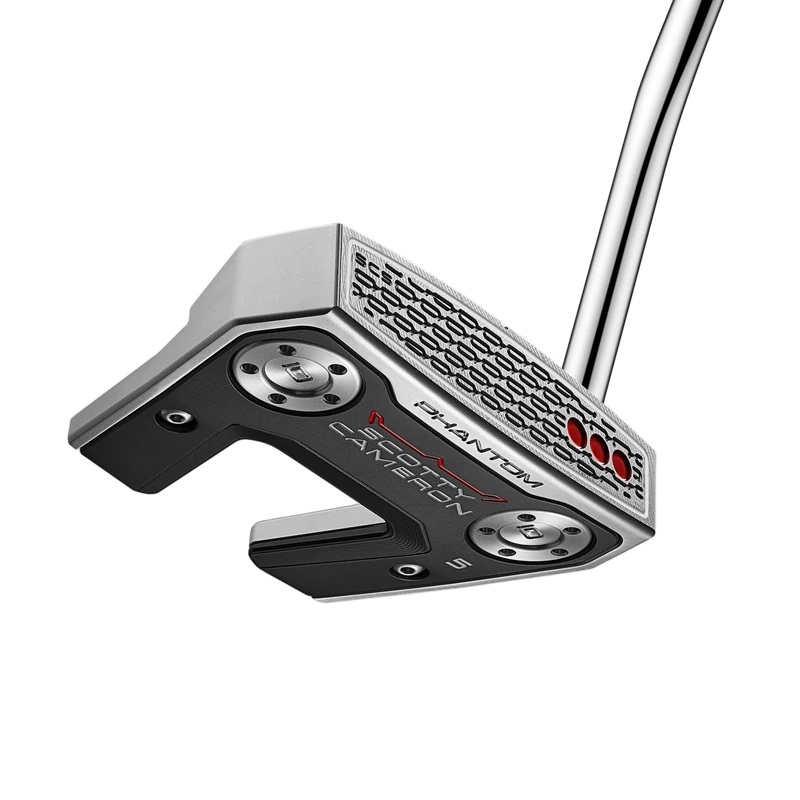 Mid-malletScotty Cameron Phantom 5
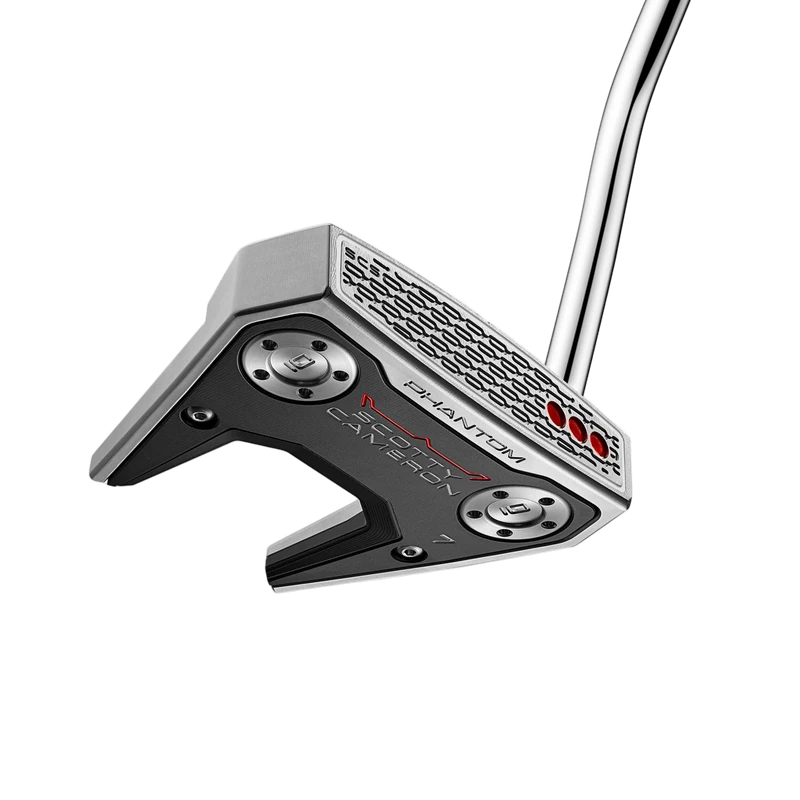 MalletScotty Cameron Phantom 7
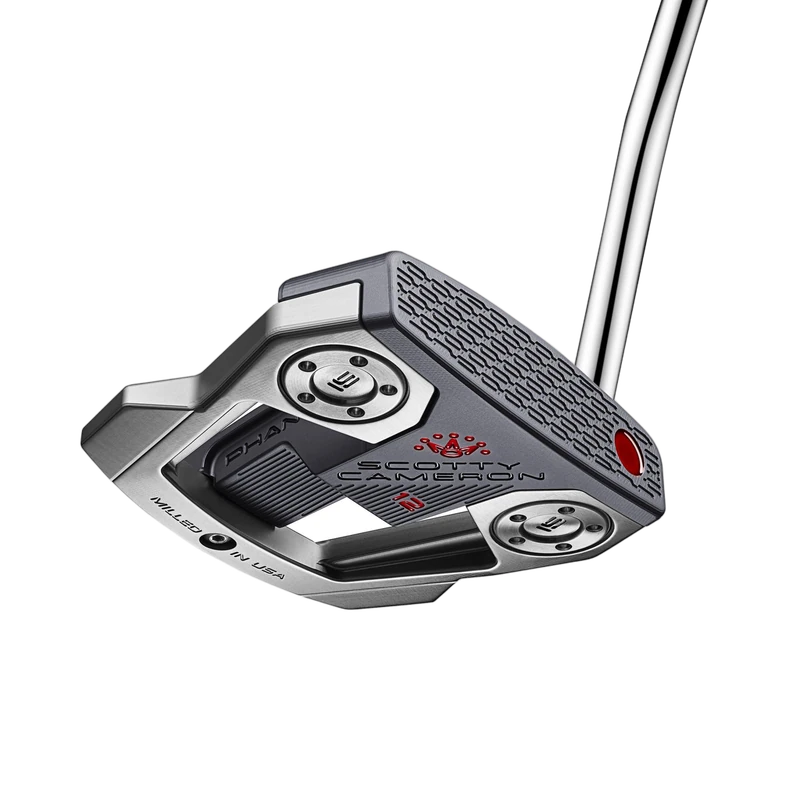 High-MOIScotty Cameron Phantom 12
| Blade | Mid-mallet | Mallet | |
|---|---|---|---|
| Head shape | Narrow bar, weight at heel and toe | Blade face with a short flange behind it | Deep head, weight pushed back and out |
| Forgiveness (MOI) | Lowest | Middle | Highest |
| Typical balance | Toe hang (86% of ours) | Mixed: 60% toe hang, 37% face-balanced | Face-balanced (61% of ours) |
| Usually suits | An arcing stroke | A slight arc | A straighter stroke |
| Feel | Most feedback on a miss | Between the two | Most stable on a miss |
| Alignment | A single line or dot | A line plus the flange | Long lines, wings or two-ball shapes |
| Models in our catalog | 352 | 180 | 456, plus 131 high-MOI |
Balance shares count the 967 published putters with a single listed toe hang; 163 more vary by build or have none published. Putter lengths are covered in the club sizing guide.
What is a blade putter?
A blade is a narrow head, roughly as deep front to back as a golf ball is wide, with most of its weight at the heel and the toe. The modern version dates to the Ping Anser of 1966, which moved weight to both ends so the head twisted less on a miss. Before that, blades were thin heel-shafted bars such as the Wilson 8802, and a few makers still sell that shape.
Because the head is small, the center of gravity sits close to the face and well out from the shaft. That is what gives most blades their toe hang, and why they tend to open on the way back and close on the way through. Golfers who play them like the feedback: you know from the feel where on the face you struck it. The cost is that a strike toward the toe or heel loses more speed than it would on a larger head.
Our catalog holds 352 blades. Among those with one listed toe hang, 86% have slight, moderate or strong toe hang and only 10% are face-balanced. See the 72 current blades.
What is a mallet putter?
A mallet is a deeper head that carries weight far behind the face and out toward the corners. Spreading the weight raises the moment of inertia (MOI), which is the head's resistance to twisting. On a putt struck off-center, a high-MOI head turns less, so the ball starts closer to your line and loses less speed. That matters most on long putts, where a small loss of speed leaves a second putt of several feet.
The second advantage is aim. A long head has room for long sight lines, wings or the paired discs that Odyssey introduced on the 2-Ball in 2001. Many golfers aim a mallet more accurately than a blade, and aim is half of putting. Winged designs such as the TaylorMade Spider, first sold in 2008, pushed MOI higher again, and we file the most extreme of them as high-MOI heads.
Our catalog holds 456 mallets and 131 high-MOI heads. Among mallets with one listed toe hang, 61% are face-balanced. The other 39% matter: 129 mallets have real toe hang, built for golfers who arc the putter but want the stability. See the 119 current mallets.
How to identify your putting stroke type
Every putter fitting chart starts from your stroke: straight back and straight through, slight arc or strong arc. Most golfers have never checked which one they have. The putter shaft leans at about 70 degrees, so nearly every stroke arcs a little; the question is how much. These three tests need a stick, a phone and ten balls.
If two tests agree, trust them. If they disagree, call it a slight arc, which is where most golfers land, and go to the next section. Left-handers should reverse the directions in the miss test.
Toe hang explained
Toe hang describes how the head sits when the putter balances freely. It comes from where the head's center of gravity lies relative to the line of the shaft. If the shaft points straight at the center of gravity, the head has no reason to rotate and rests with its face to the sky. That is face-balanced. If the shaft points nearer the heel, the toe is the heavy end and it drops. The farther it drops, the more the head wants to swing open and closed during a stroke.
How to check yours: rest the shaft across one finger a few inches up from the head, hold it level, and let the head settle. Then read the toe like a clock hand. Flat means face-balanced. Pointing at the ground means full toe hang. Most putters sit somewhere between.
The rule that follows is simple. A straight stroke rotates the face very little, so it pairs with a face-balanced head. An arcing stroke rotates the face, so it pairs with a head that rotates willingly. The stronger your arc, the more toe hang you can use.
| Balance | What you see on the finger test | Stroke it suits | Putters |
|---|---|---|---|
| Face-balanced | The face points straight up | Straight, or the slightest arc | 392 |
| Slight toe hang | The toe drops up to about 20° | Slight arc | 181 |
| Moderate toe hang | The toe hangs about 20° to 45° | Medium arc | 235 |
| Strong toe hang | The toe hangs past 45°, toward the ground | Strong arc | 98 |
| Zero-torque | The toe points up, or the head stays wherever you set it | Any; built to stop the face twisting | 61 |
The neck sets the toe hang, not the head
A maker can put the same head on different necks and get different balances. In our catalog, 90% of putters with a double bend shaft are face-balanced (206 of 229). With a plumber's neck, 96% have slight or moderate toe hang (142 of 148). With a flow neck, 79% have strong toe hang (37 of 47). So a mallet on a short slant neck can suit a strong arc, and a wide blade on a double bend can suit a straight stroke. The Scotty Cameron Phantom 7.5 is a winged mallet with strong toe hang; the Phantom 5 OC is a smaller head that is face-balanced. Read the toe hang on the spec page before you read the shape.
Treat the rule as a starting point. A sensor study of more than 5,000 putts run with Callaway found that more toe hang closes the face at impact for arcing strokes, and also that most of the variation in face angle comes from the player rather than the putter. If a putter of the "wrong" balance starts the ball on your line, it is the right putter.
Mid-mallets, high-MOI heads and zero-torque putters
Mid-mallets take a blade-length face and add a short flange behind it. You get some of a mallet's stability and a longer sight line while the head still looks compact at address. They are also the most evenly split on balance: of our mid-mallets with one listed toe hang, 60% have toe hang and 37% are face-balanced. If you like the look of a blade but miss the center often, start here. See the 44 current mid-mallets.
High-MOI heads are the largest mallets: wings, frames and tungsten at the corners. They twist least on a miss. Size does not decide balance here either. 51% of ours are face-balanced and 14% are zero-torque. See the 62 current high-MOI putters.
Zero-torque putters are the newest type. The shaft is placed so that it points through the center of gravity along the lie angle, which means the face does not try to rotate open or closed during the stroke. On the finger test the toe points up, or the head stays wherever you put it. L.A.B. Golf built the category, and Odyssey, TaylorMade, Scotty Cameron, PXG and Tour Edge now sell their own versions. We list 61 of them. They are worth a trial if your misses come from the face twisting, whatever your arc. See current zero-torque putters.
Putter length and lie
Length decides your posture and where your eyes sit relative to the ball. Most putters are sold at 34 or 35 inches, and many golfers set up better with something shorter. If you grip down the handle or your elbows are jammed into your ribs, the putter is too long. Our club sizing guide covers measuring for length, and every putter page lists the lengths the maker offers.
Lie is the angle between the shaft and the sole. When the toe or heel sits up at address, the loft on the face points the ball slightly off line, so a putter that fits your length should also sit flat. A shop can bend most putters a couple of degrees. Putter grips follow different rules from the rest of the bag, because the aim is to quiet the hands; the grip size chart explains them.
Does putter head shape actually matter?
Less than the blade vs mallet debate suggests. Fitters start with length, lie and loft because those set your posture, your aim and how the ball leaves the face. Shape comes after, and it mostly changes two things.
What head shape changes
- How much speed and direction you lose on an off-center strike
- How easily you aim the face, which depends on your eyes as much as the lines
- How much the strike tells you through your hands
- Whether you like looking down at it, which counts for more than it sounds
What matters more
- Length: posture and eye position
- Lie: a face that points where the sole says it does
- Loft: a ball that rolls instead of hopping or skidding
- Toe hang and neck: 129 of our mallets have toe hang and 30 of our blades are face-balanced
So choose in this order: length, lie and loft, then a toe hang that matches your stroke, then the head you aim best and miss least with. If you strike the center and like feedback, that is often a blade. If you miss the center or struggle to aim, it is usually a mallet.
Find putters that match your stroke
Every putter in our catalog from model years 2025 and 2026, 297 in all. Pick the toe hang your stroke test pointed to, narrow by head, and open any model for its full specs and prices.
Current putters by toe hang
of 297 putters
| Putter | Year | Head | Toe hang | Neck | From |
|---|---|---|---|---|---|
| Ben Hogan BHM01 | 2026 | High-MOI | Varies | Varies | $139 |
| Ben Hogan BHM02 | 2026 | High-MOI | Varies | Varies | — |
| Ben Hogan BHM03 | 2026 | High-MOI | Varies | Varies | $188 |
| Bettinardi 2026 BB1 | 2026 | Blade | Moderate | Plumber's Neck | $346 |
| Bettinardi 2026 BB28 Armlock | 2026 | Blade | Slight | Spud Neck | $351 |
| Bettinardi 2026 BB8 Wide | 2026 | Blade | Moderate | Plumber's Neck | $344 |
| Bettinardi BB 6.0 | 2026 | Mallet | Slight | Spud Neck | $346 |
| Bettinardi BB 7.0 | 2026 | Mallet | Slight | Spud Neck | $319 |
| Bettinardi BB1 Fitz Flow | 2026 | Blade | Strong | Flow Neck | $424 |
| Bettinardi BB28 | 2026 | Blade | Slight | Spud Neck | $185 |
| Bettinardi BB48 Fitz | 2026 | Mallet | Face-balanced | Spud Neck | $440 |
| Bettinardi BB49 | 2026 | Mallet | Moderate | Slant Neck | $324 |
| Bettinardi Workshop INOVAI 9.0 | 2026 | High-MOI | Varies | Varies | — |
| Odyssey Ai-Dual Double Wide | 2026 | Mid-mallet | Face-balanced | Double Bend | $219 |
| Odyssey Ai-Dual Jailbird Cruiser | 2026 | High-MOI | Face-balanced | Double Bend | $219 |
| Odyssey Ai-Dual Jailbird Mini | 2026 | Mid-mallet | Face-balanced | Double Bend | $195 |
| Odyssey Ai-Dual One | 2026 | Blade | Slight | Crank Hosel | $135 |
| Odyssey Ai-Dual Seven DB Cruiser | 2026 | Mallet | Face-balanced | Double Bend | $229 |
| Odyssey Ai-Dual Seven DB | 2026 | Mallet | Face-balanced | Double Bend | $239 |
| Odyssey Ai-Dual Seven S | 2026 | Mallet | Slight | Slant Neck | $199 |
| Odyssey Ai-Dual Tri-Beam 2-Ball | 2026 | Mallet | Not listed | Crank Hosel | $248 |
| Odyssey Ai-Dual Tri-Beam Double Wide | 2026 | Blade | Not listed | Crank Hosel | — |
| Odyssey Ai-Dual Tri-Beam Jailbird Mini | 2026 | Mallet | Not listed | Crank Hosel | $291 |
| Odyssey Ai-Dual Tri-Beam One | 2026 | Blade | Not listed | Crank Hosel | — |
| Odyssey Ai-Dual Tri-Beam Seven | 2026 | Mallet | Not listed | Crank Hosel | — |
| Odyssey Damascus Milled Jailbird Mini DB | 2026 | Mallet | Face-balanced | Double Bend | $404 |
| Odyssey Damascus Milled One Wide SB | 2026 | Blade | Slight | Single Bend | $547 |
| Odyssey Damascus Milled Rossie S | 2026 | Mallet | Moderate | Slant Neck | $446 |
| Odyssey Damascus Milled Seven DB | 2026 | Mallet | Face-balanced | Double Bend | $635 |
| Odyssey Damascus Milled Two CH | 2026 | Blade | Moderate | Crank Hosel | $587 |
| Odyssey Square 2 Square Ai-Dual Jailbird | 2026 | High-MOI | Face-balanced | Square 2 Square | $223 |
| Odyssey Square 2 Square Ai-Dual Max Broomstick | 2026 | High-MOI | Face-balanced | Center Shaft | $314 |
| Odyssey Square 2 Square Ai-Dual Max | 2026 | High-MOI | Zero-torque | Center Shaft | $223 |
| Odyssey Square 2 Square Ai-Dual Seven | 2026 | Mallet | Face-balanced | Square 2 Square | $223 |
| Odyssey Square 2 Square Damascus Milled Seven | 2026 | Mallet | Zero-torque | Square 2 Square | $538 |
| Odyssey Square 2 Square TRTL Max | 2026 | High-MOI | Zero-torque | Square 2 Square | $399 |
| Odyssey Square 2 Square Tri-Hot Black Jailbird | 2026 | High-MOI | Face-balanced | Square 2 Square | $279 |
| Odyssey Square 2 Square Tri-Hot Black Rossie | 2026 | Mallet | Face-balanced | Square 2 Square | $311 |
| Odyssey Square 2 Square Tri-Hot Jailbird Cruiser | 2026 | High-MOI | Face-balanced | Square 2 Square | $279 |
| Odyssey Square 2 Square Tri-Hot Jailbird | 2026 | High-MOI | Face-balanced | Square 2 Square | $303 |
| Odyssey Square 2 Square Tri-Hot Seven Cruiser | 2026 | Mallet | Face-balanced | Square 2 Square | $399 |
| Odyssey Square 2 Square Tri-Hot Seven | 2026 | Mallet | Face-balanced | Square 2 Square | $335 |
| Odyssey TRTL CH | 2026 | Mid-mallet | Slight | Crank Hosel | $349 |
| Odyssey TRTL DB | 2026 | Mid-mallet | Face-balanced | Double Bend | $349 |
| Odyssey TRTL S | 2026 | Mid-mallet | Moderate | Slant Neck | $349 |
| Cobra 3DP Agera Counterbalance | 2026 | High-MOI | Face-balanced | Single Bend | $143 |
| Cobra 3DP Agera RS Counterbalance | 2026 | Mallet | Face-balanced | Single Bend | $299 |
| Cobra 3DP Agera RS-30 | 2026 | Mallet | Moderate | Slant Neck | $269 |
| Cobra 3DP Grandsport-35 | 2026 | Mid-mallet | Moderate | Plumber's Neck | $103 |
| Cobra 3DP Supernova Counterbalance | 2026 | High-MOI | Face-balanced | Single Bend | $299 |
Each putter links to its spec page. Toe hang is the maker's published balance; "Varies" means it changes with the neck or build you order. "From" is the lowest current price we track, new or used. Models from 2024 and earlier, back to 2015, are in the putter catalog.
Putter type questions
Short answers to the blade vs mallet questions golfers search for most.
What is the difference between a blade and a mallet putter?
A blade is a narrow head with its weight at the heel and toe. A mallet is a deeper head with weight spread back and wide, which makes it twist less on off-center strikes and gives room for longer alignment lines.
Is a blade or mallet putter better for my stroke?
Match the toe hang to your stroke first. A straight stroke suits a face-balanced putter, which is usually a mallet. An arcing stroke suits toe hang, which is usually a blade. Then choose the head you aim best.
What is toe hang on a putter?
Toe hang is how far the toe drops when you balance the shaft on a finger. A face that points up is face-balanced. The more the toe hangs toward the ground, the more the head rotates during the stroke.
How do I know if my putting stroke is straight or arced?
Make a stroke over an alignment stick and watch the head at the end of the backstroke. If it stays over the stick the stroke is straight. If it moves inside the stick, the stroke arcs.
Are all mallet putters face-balanced?
No. In the StickPicker catalog 61% of mallets with a listed toe hang are face-balanced. The rest have toe hang or are zero-torque, because the neck decides the balance, not the head shape.
What is a zero-torque putter?
A zero-torque putter has its shaft aligned with the center of gravity so the face does not try to twist open or closed during the stroke. L.A.B. Golf started the category and most major brands now make one.
Find putters matching your stroke
Add a putter to your bag and see the whole 14-club build, with prices, in one shareable link.